
Most quality programs are one audit away from a very uncomfortable conversation.
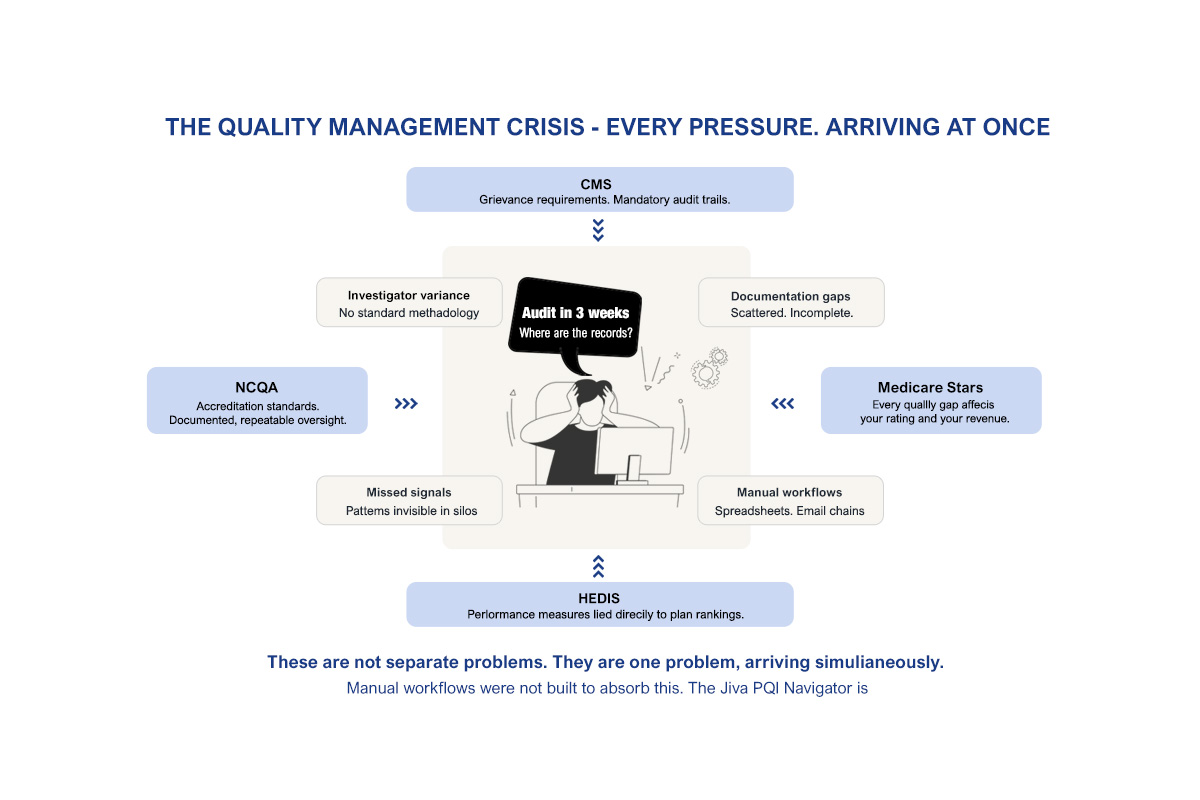
Not because the work is not being done. It is. Quality teams are investigating complaints, reviewing cases, documenting findings, every single day. The problem is not effort. It is what the effort produces: a scattered, inconsistent, investigator-dependent body of evidence that looks fine from the inside and fragile the moment a CMS examiner, NCQA reviewer, or internal compliance team starts pulling threads.
Regulators, accreditation bodies, providers, and members are all watching. And what they are looking for is not just proof that a concern was raised. It is proof that it was handled consistently, rigorously, and in a way that would hold up to scrutiny six months later.
For most health plans, that proof is harder to produce than it should be.
The patchwork is the problem
Ask yourself honestly: if a quality-of-care complaint came up in an audit today, could your team reconstruct the investigation cleanly? Could you show a consistent methodology, a complete evidence trail, a documented determination, and proof that similar issues were monitored for recurrence?
If the answer involves opening three spreadsheets and searching through email chains, you already know the risk.
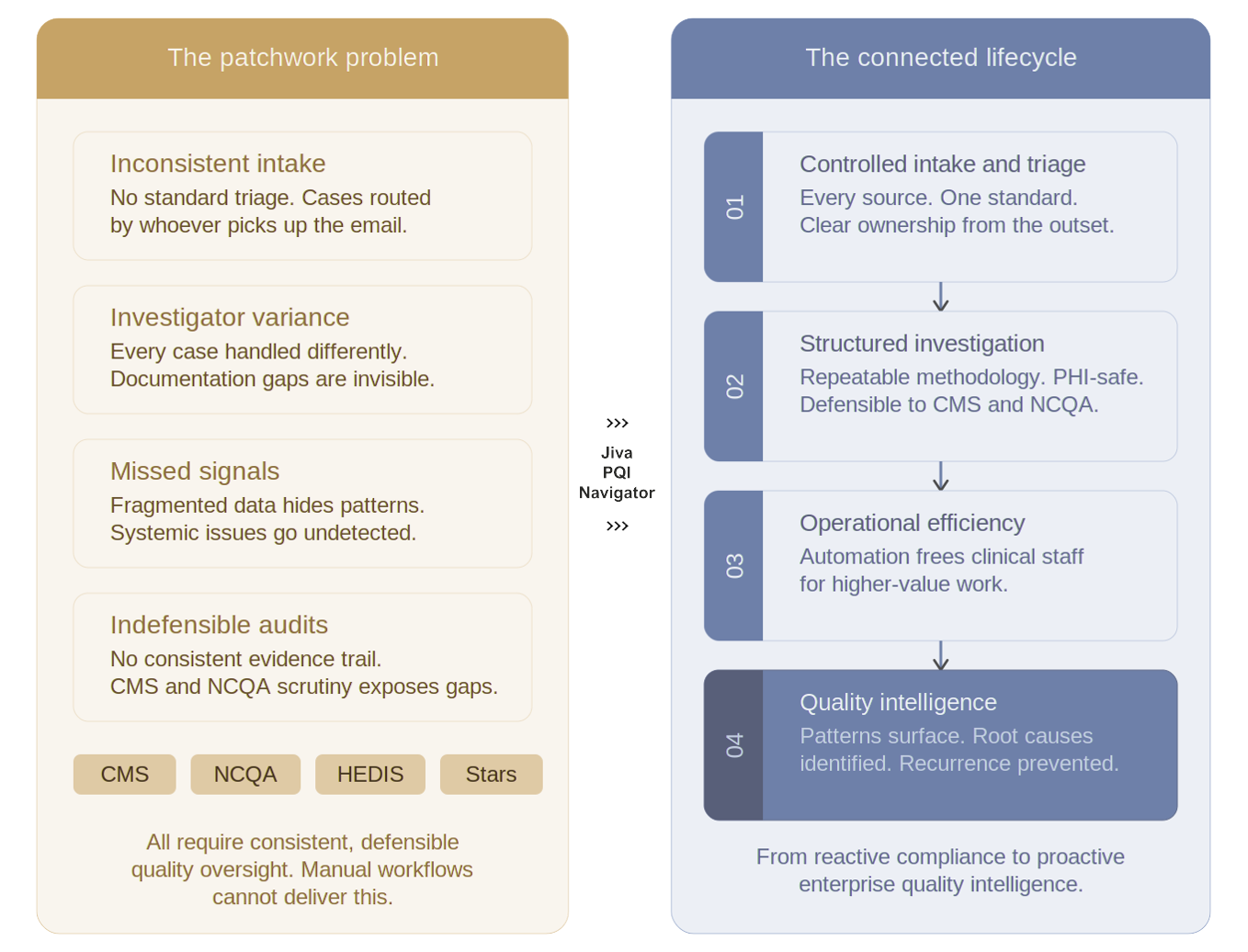
The issue is not that people are not trying. It is that the infrastructure makes consistency structurally impossible. When triage criteria live in someone's head, when investigation methodology varies by who picked up the case, when documentation is scattered across disconnected systems, every case handled differently is a liability waiting to be discovered.
And the signals being missed are not small. Delayed diagnoses. Medication reconciliation failures. Preventable readmissions. Inappropriate utilization decisions. Provider performance concerns. These are not administrative nuisances. They are early warnings of systemic breakdowns in care delivery. Left unaddressed, or inconsistently addressed, they do not stay isolated. They escalate. And when they escalate under regulatory scrutiny, the conversation gets very uncomfortable very fast.
This is the structural problem Potential Quality Issues (PQI) Navigator solves
A lifecycle that compounds, not just closes
The PQI Navigator is not case management software with a quality veneer. It is a connected investigation lifecycle designed so that every stage builds on the last, and the organization gets smarter with every case it closes.
01: Controlled intake and triage
It starts at the source. Member grievances, utilization management reviews, provider complaints, clinical audits, care management workflows, external reporting. Every channel feeds into a single, standardized intake process. Cases are categorized, prioritized, and routed the same way every time. No routing ambiguity. No unclear ownership. No issues falling through the cracks because someone was not sure whose queue it belonged in.
Consistency at intake is what makes everything downstream defensible.
02: Structured investigation and defensible documentation
Once a case opens, the investigation itself becomes the compliance asset. Evidence collection, clinical review, investigator collaboration, determination tracking, corrective actions, resolution documentation. All of it follows a repeatable, structured methodology. Not because investigators cannot exercise judgment, but because judgment without structure produces variance, and variance is what auditors find.
PHI protection is embedded throughout, enabling quality, clinical, compliance, and operational teams to collaborate across functions without compromising HIPAA adherence. As regulatory scrutiny around healthcare data governance continues to intensify, treating this as an afterthought is no longer an option.
03: Operational efficiency at scale
Here is what manual investigation workflows actually cost: not just time, but capacity. When quality teams spend their hours gathering documentation, chasing approvals, and compiling audit reports by hand, they have less time for the work that actually improves care: analysis, remediation, pattern recognition, improvement initiatives.
The Potential Quality Issues (PQI) Navigator automates the coordination overhead. Workflows move. Cases resolve faster. Clinical staff get their bandwidth back. And over time, the operational savings compound into something measurable.
04: From case closure to quality intelligence
This is the capability that changes the game.
Most case management tools are designed to close cases. The Potential Quality Issues (PQI) Navigator is designed to learn from them. By centralizing structured investigation data across the enterprise, the platform surfaces what individual case reviews never could: recurring provider trends, systemic care gaps, emerging patient safety patterns, and real evidence of whether prior corrective actions are actually working.
This is how PQI management stops being a compliance obligation and becomes a strategic capability. Not just knowing that issues occurred. Understanding why they occurred, where they are concentrating, and how to intervene before they recur.
Built to work in your environment, not against it
The Potential Quality Issues (PQI) Navigator is a standalone solution designed to fit the infrastructure health plans actually operate, not an all-or-nothing platform play. It connects with care management, utilization management, population health, quality improvement, and payer operations workflows, no matter which vendor system they run on. The result is a unified view of quality performance across the enterprise, without ripping out what is already working.
The Future of Quality Management Is Here
Health plans operate in an increasingly complex environment where member safety, patient outcomes, regulatory requirements, and organizational quality goals are closely aligned. Potential Quality Issues (PQIs), member grievances, utilization management, state and health plan policies, and accrediting body requirements all rely on a consistent approach to quality oversight. By modernizing quality investigations with connected, standardized workflows, organizations can strengthen member safety, improve outcomes, and drive continuous quality improvement.
As care delivery evolves with increasing transitions, delegated relationships, complex data environments, and higher member expectations, health plans need modern quality management approaches that provide greater visibility and proactive insight. Connected, standardized workflows help organizations strengthen member safety, improve outcomes, and confidently navigate an evolving quality landscape.
The organizations best positioned for success are those that have transformed quality operations with connected, standardized workflows that enable smarter decisions, strengthen compliance, and drive continuous quality improvement.
