


Integrated Identification & Stratification: Powering Whole-Person Population Health at Scale
As healthcare organizations continue their shift toward value-based care, population health management has become both more critical and complex. Care teams are expected to identify risk earlier, intervene more precisely, and manage increasingly diverse member needs, often with fragmented data and limited resources.
Traditional approaches to risk stratification in healthcare, built on narrow clinical rules or retrospective claims data, are no longer sufficient.
Organizations need an integrated, clinically grounded approach that connects healthcare risk identification, stratification, and action across the full spectrum of member risk.
This is where ZeOmega’s Integrated Identification & Stratification (IDStrat) solution delivers a meaningful advantage.
Purpose-built within ZeOmega’s population health management ecosystem, IDStrat enables payers and providers to identify risk sooner, stratify populations more accurately, and align care management resources with real-world member needs – supporting whole-person care at scale.
Precision Risk Intelligence for Population Health Management
At its core, IDStrat provides precision risk intelligence through a unified, multi-dimensional view of member risk. Instead of relying on isolated data sources, it brings together:
- Clinical data, including diagnoses, labs, and utilization patterns
- Behavioral health indicators
- Chronic condition progression and compliance signals
- Maternity-related risks across the care continuum
- Medication safety and high-risk drug triggers
- Social determinants of health (SDOH) factors
By integrating these inputs into a single population health management framework, IDStrat creates a more complete and actionable member risk profile, supporting earlier intervention and more informed care management decisions.
A Unified Identification Framework Across Population Health Domains
ZeOmega’s IDStrat is designed as an organized, rules-driven triage system — not a collection of disconnected analytics. Its clinical breadth is delivered through four tightly integrated engines that support healthcare risk identification across key domains:
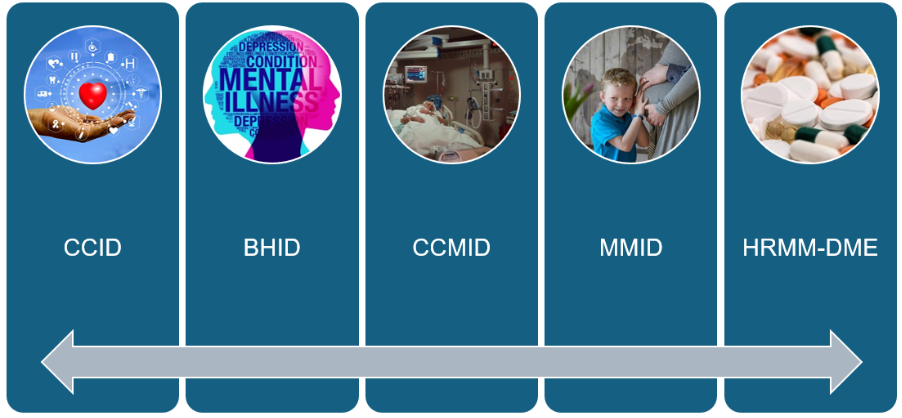
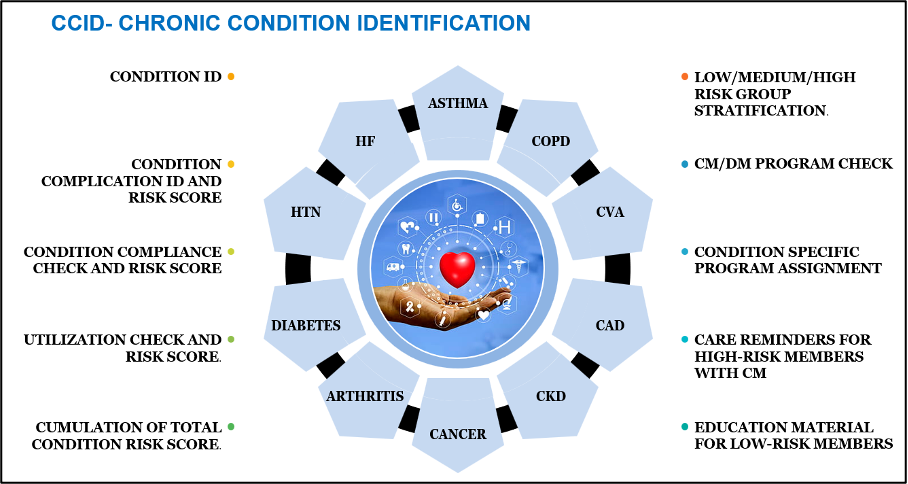
i. Chronic Condition Identification (CCID)
CCID detects chronic conditions, disease exacerbations, and care gaps using clinically validated rules. This enables proactive management of high-impact conditions before they escalate into avoidable utilization.
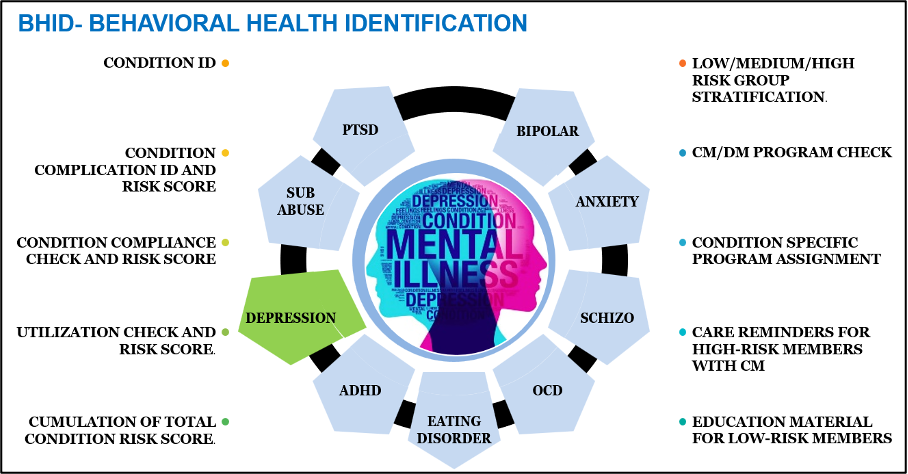
ii. Behavioral Health Identification (BHID)
Behavioral health conditions often drive medical complexity and cost, yet they are frequently under-identified. BHID surfaces mental health and substance use risks that may otherwise remain hidden, supporting more coordinated, whole-person care.
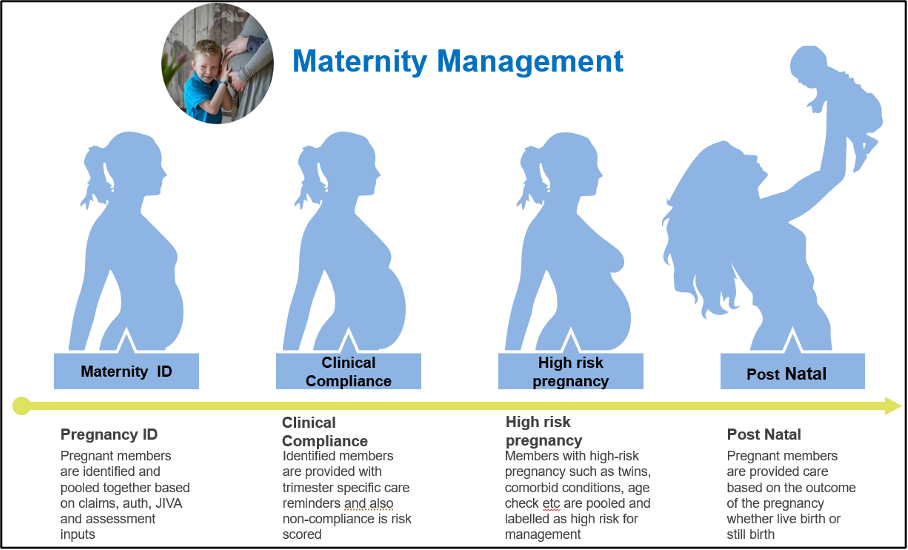
iii. Maternity Identification & Management (MMID)
MMID identifies maternity episodes early and flags high-risk pregnancies, helping care teams align prenatal and postnatal interventions, improve outcomes, and reduce preventable complications.
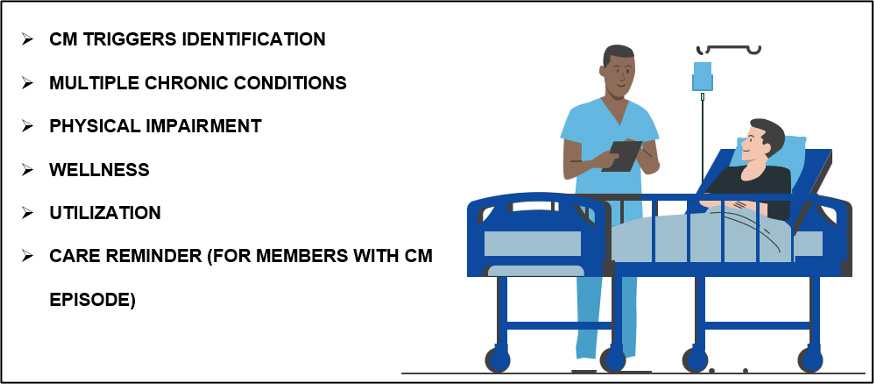
iv. Complex Case Management Identification (CCMID)
CCMID recognizes members with multiple chronic conditions, high utilization, physical impairments, and medication-related risks – ensuring that the highest-need populations receive appropriately intensive care management.
Together, these engines ensure that members are identified accurately, stratified consistently, and routed to the right level of support as their needs evolve.
Medication Safety Intelligence that Reduces Preventable Risk and Cost
Medication-related risk is a major contributor to avoidable admissions, adverse events, and unnecessary cost. IDStrat incorporates advanced medication intelligence directly into its identification and stratification logic, including detection of:
- High-risk and moderate-risk medications
- Antipsychotic use and concurrent prescribing in pediatric populations
- Opioid and physiotherapy overutilization for low back pain
- Gaps in long-term therapy monitoring and adherence
By addressing medication risk management as part of population health management, IDStrat helps organizations reduce preventable risk while supporting clinical quality and patient safety initiatives.
Turning Risk Insight into Action with Cumulative Integrated Risk Scoring
Identification alone is not enough. IDStrat translates multi-dimensional risk data into action through a Cumulative Integrated Risk Score.
Using evidence-based rules, this score provides care teams with a clear, forward-looking view of member risk.
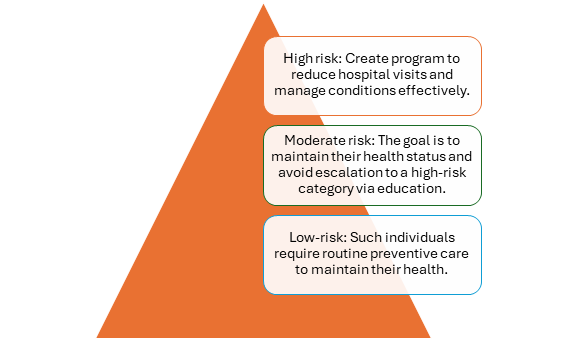
IDStrat automatically stratifies members into clear risk tiers:
- High Risk – Intensive care management
- Moderate Risk – Condition-focused coaching and monitoring
- Low Risk – Preventive education and engagement
This structured stratification ensures that limited care management resources are applied where they matter most – reducing inefficiencies, supporting workforce optimization, and improving outcomes across the population.
What Makes ZeOmega’s IDStrat Different
Several factors distinguish ZeOmega’s Integrated Identification & Stratification approach:
- Deep clinical expertise embedded in the rules, developed by clinicians, analysts, and population health experts.
- Seamless integration with ZeOmega’s Jiva platform and enterprise workflows, enabling immediate action without operational disruption.
- Demonstrated population health impact, including reductions in avoidable emergency department visits, hospitalizations, and high-cost utilization.
- A scalable and configurable architecture that supports ongoing enhancements, client-specific needs, and evolving industry standards.
IDStrat is not a standalone analytics tool. It is an operational foundation for effective care management.
Continuous Innovation to Stay Ahead of Evolving Care Models
Recent and ongoing enhancements to IDStrat include:
- Updated and refined risk groupings
- Expanded chronic and behavioral health identification rules
- Enhanced high-risk medication detection
- Improved maternity risk analytics
- Greater precision in identifying rising-risk populations
ZeOmega continues to invest in clinical innovation to ensure IDStrat remains aligned with regulatory requirements, quality programs, and value-based care models.
Delivering Measurable Outcomes Across Population Health Goals
By combining whole-person insights, advanced analytics, and workflow integration, ZeOmega’s IDStrat helps organizations:
- Improve quality performance across Star and HEDIS measures
- Reduce avoidable medical spend
- Support health equity initiatives
- Empower care teams with actionable intelligence
- Meet value-based care performance benchmarks
- Deliver more personalized, proactive member experiences
A Stronger Foundation for Value-Based Care and Population Health
As healthcare organizations take on greater accountability for outcomes, success depends on the ability to identify risk early, stratify accurately, and act decisively.
ZeOmega’s Integrated Identification & Stratification framework provides the clinical depth, automation, and operational alignment needed to transform population risk from a challenge into a strategic advantage.
With ZeOmega, organizations can deliver the right care, at the right time, to every member – at scale. Contact us to learn more.
